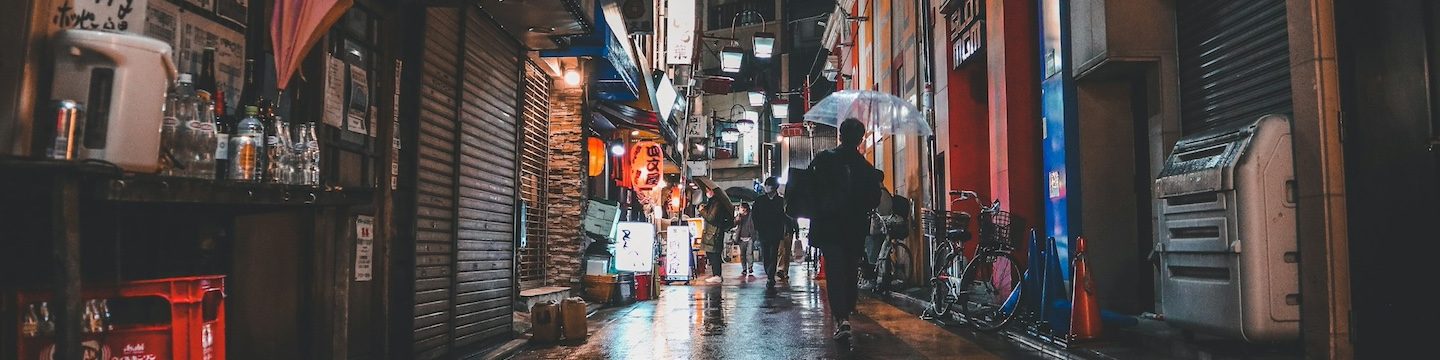


The Last Picture Show
Fiction by Ryu Murakami
Translated from the Japanese by Ralph McCarthy
I was eighteen.
I’d just come up to Tokyo from a port town in Kyushu that had a US naval base, and was living with some friends in a crummy little apartment in a wooden building in Kichijoji, just north of Inokashira Park. These friends had formed a blues band back home and dreamed of making it big in the big city. I played drums but wasn’t really passionate about carrying on with a band from the boondocks. My main priority had been to get away from my parents, who’d agreed to stake my move to Tokyo and send me an allowance if I enrolled in a college prep school there. The other guys worked as busboys or waiters while looking to launch their career as professional musicians, but I wasn’t working. At this point I was living with them only because staying was easier than trying to find a room on my own.
The plan was to work nights, practice during the day, attend big concerts to meet the right people, and audition for record companies and production agencies. On the overnight train from our hometown, we’d set ourselves the goal of making it onto the stage at the Hibiya Park concert series within six months. There were, including me, five members, from a variety of backgrounds. Nakano, the bass player and leader, had a salaryman father who’d just retired; the guitarist Yamaguchi’s father ran a small import-export firm, and his mother was a piano teacher; Shimada on organ was the only child of a filling station owner; and Kato the vocalist had been raised by a single mother. Our financial circumstances differed too, of course—Nakano and Kato had virtually run away from home, and neither had so much as a futon or a rice bowl to his name, whereas Shimada’s folks sent him a package of food and clothing and a registered envelope full of cash every week, and Yamaguchi had a stereo system with an open-reel tape deck.
All four of them got jobs as busboys and waiters: Kato and Shimada at discos in Roppongi, Yamaguchi at a live-music club in Shinjuku, and Nakano at a cabaret in Ginza. But the plan to work nights and practice in the daytime proved undoable from the outset. The places they worked at were all open from about six in the evening to eleven at night, but busboys and waiters had to get there two or three hours early and stay till well after closing time to clean up or wash dishes. Nakano would leave the apartment at two in the afternoon and stagger home at about two in the morning, having caught the last train. There were cabarets nearby—right there in Kichijoji, even—but Nakano believed that only in Ginza could you make connections in the blues music field. God knows where he got an idea like that, which in retrospect just sounds like a bad joke.
Shimada had brought a mike and amp from Kyushu, and everyone except me had brought their instruments. Drums take up a lot of space, and mine had been secondhand in the first place and were slowly disintegrating, so I’d promised to get a part-time job and buy a new set with the money I made. But my heart wasn’t really in it any more. I had brought my sticks, and joined in the practice sessions by drumming on the tatami mats, but the whole thing was beginning to feel more and more hopeless. Waiters and busboys got about one day off every two weeks, and it was a different day at each place. My roommates would straggle home late at night so exhausted from the unaccustomed toil that after eating the instant ramen I made for them, and without exchanging more than a few words, they’d crawl into their futons and pass out. The only time we could all get together to practice was the short stretch from late morning to early afternoon, but even then we could rarely coax our single amp into accommodating the organ, guitars, and vocals all at once. The one time we did get a fairly big noise going, on the Spencer Davis Group’s “Gimme Some Lovin’,” the guy living upstairs burst into our apartment and gave us hell. He was a thin young yakuza with oddly angular, pointed features. Nakano and Shimada were hard-core hoodlums back home, known even to kids at other high schools, but they had no answer for a genuine Tokyo gangster bellowing in their faces.
When a month had passed and there’d been no progress for the band, a cloud of powerless frustration began to form in the apartment, and soon it was raining down on me: Yazaki, when the hell are you gonna get a job and buy some drums? I told them I was trying to decide whether to continue with the band or go to college. The band was the reason everyone was pooling their money to rent the apartment, however, so I knew if I dropped out I’d have to leave. A relative of Shimada’s had found the place, which wasn’t cheap, in spite of being only two small rooms and a smaller kitchen, with a pit toilet and no bath, and a twenty-minute walk from Kichijoji Station. I was in no position to hit my parents up again for moving expenses, and having just emerged from eighteen years in the sticks I had no idea how to go about finding a place of my own anyway.
I wasn’t attending prep school and wasn’t looking for a job. Most days I’d browse through the used book stores in Kanda, buy some old novel or poetry collection, then hang out for hours in a coffee shop where they played jazz or rock.
By the time two months had slipped by, a real storm was brewing, and one night, when Nakano said he’d found an opening for a waiter and I refused to apply for it, we nearly got into a fistfight. “Nakano’s right, Yazaki didn’t keep his word, but there’s no sense in fighting, we didn’t come up to Tokyo just to squabble,” Yamaguchi said, and actual blows were averted, but there was no room for me in there just then: everyone’s eyes showed me the door.
It was about two in the morning. The rock café I usually went to was closed, and since my allowance hadn’t arrived yet I was all but broke. It was June, the air was warm and moist, and Inokashira Park was blurry with a gray mist. I felt like shit emotionally, and the damp, heavy air stuck to my skin like wallpaper. Having nowhere else to go, I headed down a deserted footpath through some trees, toward the pond. Beneath the trees, couples were making out on secluded benches here and there, and as I stumbled along I could hear the flapping of wings and the cries of water birds down below. Their strangled, nasal screeches reminded me of Van Morrison screaming the blues, and I wondered why I and the others had ever aspired to play music like that in the first place.
Performing in a bar full of American sailors, many of them black, in a port town on the western edge of Kyushu, it was easy to think of the blues as somehow being the mother lode of all music. John Lennon, Mick Jagger, and Bob Dylan had all sprung out of the blues, the blues was played all over the world, the roots of all soul music and rock ’n’ roll were in the blues. We’d believed this then, and believed it would become even clearer to us when we got to Tokyo, but in fact we hadn’t heard live blues even once since coming to the city. At rock cafés they’d rarely play a blues record, and on the street or the plaza in front of Shinjuku Station people performed nothing but mawkish antiwar folk tunes. Our music was nowhere to be found in Tokyo. Listening to records from Shimada’s and Yamaguchi’s amazing collections at low volume in our shit apartment just wasn’t the same as letting them blast in our old navy-base port town. That’s how I felt, and I suspected the other four felt it too. At discos, live-music clubs, and cabarets you could only hear Filipino cover bands or pop vocal groups or cheesy enka singers. Recently Kato had proposed we give up and go back home, but Nakano’s argument—that you can’t tell anything after only two months—won out. The consensus seemed to be that to go home before we got anywhere at all would be too pathetic.
I reached the pond, and as I followed the path around it, I was thinking that things were probably just going to get worse. I had to move out or buy drums, but either way it was going to take money, and I’d just decided to look for a job the next day when by the glow of a streetlamp I caught sight of the yakuza who lived in the upstairs apartment. He was standing off the path, next to some big round bushes, and as I tried to slink by with my head down he stopped me, saying, “Hey you, wait up.” He was wearing work gloves, a baggy black shirt, and loud checked trousers that clung to his skinny hips. A large blue plastic trash bag sat open-mouthed on the ground beside him.
“C’mere a minute.”
I was preparing to receive a punch as I sidled slowly over to him, and decided that if it didn’t stop at one, I’d probably be better off putting up some resistance.
“You know me, right? I live upstairs from you,” he said, and I nodded. “What’s your name?”
He looked to be in his late twenties. His sweaty face was the kind that would go well with a switchblade—narrow eyebrows, slanted eyes, hollow cheeks, thin nose, small mouth. I told him my name.“Oh yeah? I’m Tatsumi. You wanna gimme a hand here? We can work something out.” He pointed at the shrubs. Hydrangeas. “I’ll give you three . . . No, five hundred yen.”
For doing what, I asked, and he said, for picking leaves.
“The new ones are best, pick ’em and put ’em in this plastic bag.”
I did as he told me. But I wondered what he was going to use hydrangea leaves for.
“I dry ’em and sell ’em,” he said proudly. “Dry ’em, crush ’em, and roll ’em—they smell and taste exactly like marijuana. You know what that is, right, a hoodlum like you?”
It felt funny being called a hoodlum by an actual yakuza. I had tried marijuana a number of times back in our port town. American sailors would smoke joints like regular cigarettes at the bars that catered to them, so I had no real sense of the stuff being illegal. Nakano and the others were always complaining that there was no weed in Tokyo. Naturally you could get any drug you wanted if you knew where to look, but the availability was nowhere near what it had been back home.
“I thought this up myself. The great thing is that it’s not against the law, and nobody knows it’s hydrangea leaves, but even if they did, it’s not like they could go to the cops and complain, right?”
Picking hydrangea leaves in Inokashira Park in the middle of the night somehow felt like more of an offense than smoking real pot in my hometown. It was harder work than I expected too. All I had to do was choose new, soft leaves, pluck them off, and stick them in the bag, but all the crouching and twisting was rough on the lower back, and since the night was warm and humid I was soon dripping with sweat. We’d nearly filled the first bag when we heard a bicycle approaching. Tatsumi jumped behind the bushes, so I did the same. It turned out not to be a policeman but a boy delivering milk, and as we got back to work, I said it wasn’t as if we were doing anything bad, after all. Looking like a man haunted by some bitter memory, Tatsumi furrowed his narrow brow and muttered:
“Cops never give you the benefit of the doubt.”
By the time we’d filled two big plastic bags with hydrangea leaves, the eastern sky had begun to brighten. On the way back to the apartment building, he and I exchanged life stories. I told him I was in my second month in Tokyo, fresh out of Kyushu, that my friends were trying to make it as a blues band, and that I was thinking of trying to find a job. Tatsumi, to my amazement, was only three years older than me. He told me that he’d been connected with his syndicate, which had its offices in Shinjuku, since middle school; that nowadays even a yakuza needs a good education; that he was living with a bar hostess who was about the same age as his mother; and that he called this woman Nee-chan, as if she were his older sister.
“Can’t be easy to show your face down there when your pals have all slagged you off. Nee-chan’s not around today—you wanna crash here?”
Tatsumi’s apartment had the same layout as ours, but the smaller of the two rooms was taken up by a huge double bed and reeked of cosmetics and perfume.
It was some time after noon when I got up from my bed on the floor and started helping to make the hydrangea joints.
Tatsumi didn’t sun-dry the leaves. “You think I can just lay ’em out on the roof?” he said, and smiled. He had a strange smile, of a sort I’d never seen before. It wasn’t an embarrassed or awkward smile, but it wasn’t a mean one either. It was as if the muscles in his face weren’t used to such a configuration and were trying to figure out what exactly to do. He roasted the leaves in a frying pan over a high gas flame. “You gotta get all the moisture out,” he told me, “but you don’t wanna scorch ’em. Takes experience.” Before taking the leaves off the fire, he added two or three drops of the breath freshener Pio. “That’s the secret ingredient, the Mint To Kiss With, gives it the taste of your best imported shit,” he said, and laughed. I was in charge of crumbling the dried leaves and rolling the joints. Tatsumi was impressed.
“You really do know your shit,” he said.
That night I went with him to Shinjuku to sell the product. He chose a back street between the concert hall and the park. Mostly he tried to make his pitch to drunks. They generally just waved him off, but one couple, seeing him approach in his baggy shirt, turned and ran for their lives. We had about a thousand joints stashed in a duffle bag. They were in cellophane-wrapped bundles of ten, but we were willing to sell them individually as well, at a thousand yen each.
“Are they always so hard to sell?” I asked.
“To tell the truth,” he said, “I’ve never actually tried making a whole batch like this before. I made five or six joints a couple of times and sold ’em to assholes with long hair, like you. Where do assholes like you hang out?”
A rock café I went to a lot was nearby, but I wasn’t sure I should tell him about it. People there would gladly pay a thousand yen per stick, but they were dope connoisseurs, and once they found out it was fake I’d never be able to go there again. And since no one would buy this stuff more than once, the only sensible thing to do was to go for a big sale. I was to get twenty percent of whatever we took in, but I wasn’t happy with that and asked him to make it forty. For forty percent I’d take him to a place full of hippies and introduce him around. We finally agreed on thirty-five. But now we’d need two or three real joints.
“What for?” Tatsumi asked.
I told him I wanted to sell at least four hundred sticks. “If we sell small amounts to people and they don’t get high, they’ll tell everyone, and there goes the market. We want to sell to dealers, so we’ll need samples.”
Clever boy, Tatsumi said, patting my cheek. We went to a small, grubby disco where GIs from the base in Yokota and sailors from Greece and Turkey hung out, bought three genuine joints, then went back to my rock café to wait for the dealers to arrive. Inside, a Pink Floyd record was playing at ear-splitting volume.
“I can’t take this!” Tatsumi shouted in my ear. “Fuck this place!”
Nine o’clock in the evening was too early for the dealers to appear anyway, so we decided to kill time at a movie. The Last Picture Show was playing at an all-night theater down the street. Tatsumi balked at first, saying he didn’t like movies with foreigners in ’em, but halfway through the film he was stifling sobs.
“Never saw a movie like that before,” he said, at the diner where we stopped for a couple of beers before returning to the rock café. “You always watch things like that?”
Not really, I said.
“So, what did ya think of it?”
I said it made me realize that there are lonely people even in America.
“What’s that supposed to mean?”
The sailors in my hometown all acted so cocky, I told him—great big guys, always smiling, always looking like they’re having fun, so I used to think all Americans were rich and happy.
“I don’t know what the hell you’re talking about,” Tatsumi said. He sat with his head bowed. “I guess there must be guys like that over there too, though—guys who fall for way older women.”
He said nothing else for a while but sat brooding over his beer.
Tatsumi was no drinker, and after three beers his legs were wobbly. We went back to the rock café, where the Doors were now rattling the walls, and I introduced him to a group of three dealers out of Yokosuka, telling them he was a yakuza who’d just arrived from Okinawa. Between them they bought nearly three hundred joints.
“Nee-chan, meet Yazaki. Don’t mind the long hair, this kid’s got some brains on him.”
We’d gone home by taxi. The lights were out in my apartment, but in Tatsumi’s the woman he called Nee-chan was sitting there in a slip, eating instant ramen. Easily old enough to be his mother, or mine, she wasn’t wearing a bra and hadn’t shaved her armpits recently. She said nothing, not even to acknowledge me, but as I watched this heavily made-up woman calmly slurping her noodles, a lighted cigarette in one hand, I felt as if I understood why Tatsumi had teared up at The Last Picture Show. Timothy Bottoms, living in a small town in the Midwest or wherever, chooses a lonely married woman about twice his age as his partner for sex. In the final scene he decides to leave town and starts to drive off in his pickup truck but then makes a U-turn and goes back to her place. That tired older woman was a symbol of America—an America that had lost something it once had.
“Look how much we made, Nee-chan, me and him.”
Tatsumi took a roll of ten-thousand-yen bills from the pocket of his gaudy trousers and put it down in front of her. She set her ramen bowl aside and began counting the bills, wearing the same non-expression she’d worn while inhaling her noodles.
“Where have you been?” Nakano said when I walked into our apartment. “Everybody was worried about you.”
He was the only one still up and was in the kitchen in undershorts and a shirt, drinking Suntory’s cheapest whiskey.
“We all talked things over today,” he said. “Kato’s mother got sick again, and he wants to go back. Let’s face it, we can’t be a band anyway, living like this. Shimada says he’s going to take a job as a roadie for some group he knows, and Yamaguchi said he wants to go to a jazz guitar school, and me, well, I haven’t decided what to do yet, but I’m tired of this. Maybe it is pathetic to give up after two months but c’est la vie, man, we could do this for a year and not get anywhere. So, anyway, three weeks from now, on Sunday, we’re going to give a little concert in the park. How about it? Shimada says he can borrow some drums. You’ll join in, right? It might be the last time we ever play together. There’s this little outdoor stage in a corner of Inokashira Park where they put on concerts, mostly by folk groups, every Saturday and Sunday afternoon. I happened to meet the guy who produces it and asked him if we could play and he said ‘Sure,’ just like that.”
“No thanks,” I said. “I got hold of some money, so tomorrow I’m going to look for a place of my own. But I’ll definitely come watch you play.”
I found an apartment easily enough, not too far away, and was able to move my few belongings in a taxi. It was a tiny room, just four and a half mats, and I had enough cash left over to buy a stereo. My lifestyle didn’t change much: I still bought old novels and poetry collections at used-book stores and read them in rock or jazz cafés. When I ran out of money, I’d look for a hydrangea bush, make some dummy joints, and sell them in Akasaka or Roppongi. I avoided Shinjuku, but once bumped into the dealers from Yokosuka at a disco somewhere. Apparently they hadn’t even realized the product wasn’t real, though. It wasn’t very good stuff, was all they said.
That Sunday, the little outdoor stage in the park was infested with folksingers and trios who did one grindingly boring song after another. About thirty people sat around listening, and the applause ranged from restrained to nonexistent. When Nakano and the others began to play, an elderly couple who’d been feeding bread to the pigeons got up and left, plugging their ears. And after doing only two John Mayall pieces, the drumless blues quartet retired forever. All four seemed to enjoy themselves, though, and when their abbreviated set was over they sat on the side of the stage sipping soft drinks and laughing at the folkies that followed them. Nakano spotted me and beckoned me over, but I just waved and shook my head. I wanted to take a walk around the pond. A few minutes later I was sitting on a bench near the hydrangea bushes Tatsumi and I had trimmed. The rainy season was over, and the blossoms were withering away. Looking at those fading flowers, remembering the muggy night we’d crouched there picking the leaves, I felt a sudden loathing for that movie, The Last Picture Show. I’d never forgive it for making a guy like Tatsumi cry.
I decided I wanted to see him and went to the old apartment building.
“Nee-chan’s here, but come on in.”
The woman was getting ready to go to work. She was wearing a red lamé dress and a lot of makeup, and was painting her toenails. The air was so thick with the smell of nail polish, it was hard to breathe. Tatsumi was toasting hydrangea leaves in a frying pan. The woman glanced at me but offered no greeting. I sat there silently watching her apply the red polish to every last nail.